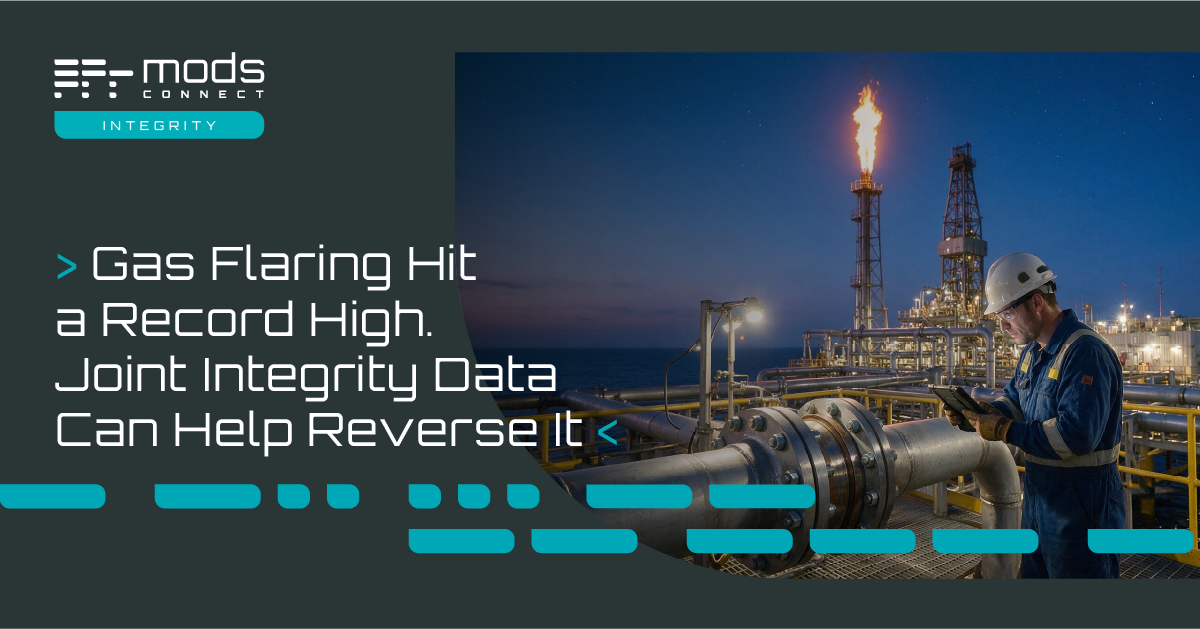
Global gas flaring rose for a third consecutive year in 2025, and the increase is largely preventable. The real problem isn't missing technology. It's underinvestment in equipment integrity and digital maintenance practices.
The latest World Bank Global Gas Flaring Tracker Report 2026 reveals a troubling reality for the energy industry. Despite years of commitments, technological advances and net zero ambitions, gas flaring has increased for the third consecutive year, reaching the highest level recorded since 2019 at a whopping 167 billion cubic meters.
It’s an eye-catching headline from which all manner of narratives can be spun. But the objective – and staggering – economic cost amounts to an estimated loss of around 54 billion USD. The volume of gas unnecessarily burned last year from flaring was enough to rival the annual gas consumption of the entire African continent. It also exceeded the amount of liquefied natural gas (LNG) transported through the Persian Gulf during the same period. Instead of powering homes, supporting industry, creating jobs, or improving access to cleaner cooking fuels, this valuable natural resource literally went up in smoke.
Interestingly, the investment required to eliminate flaring would only amount to approximately 70–100 billion USD, the equivalent of less than two years of loss. These economics strongly favor action over continued waste. The point being: eliminating flaring isn’t a technical challenge but rather one of regulatory inaction, underinvestment, inadequate infrastructure, and perhaps lack of operational priority.
In spite of this stalemate, the World Bank reports optimistically. Countries such as Kazakhstan have demonstrated what is possible, reducing flaring by nearly 90 percent since 2012, while the United States achieved the largest absolute reduction of any nation during 2025. These examples show that meaningful progress is achievable when investment, policy, and operational discipline align.
Looking Beyond the Flare Stack
When discussions turn to flaring reduction, attention naturally focuses on gas capture projects, pipeline infrastructure, and recovery technologies. While remain essential components of the solution, there is another, less visible opportunity: preventing the conditions that lead to unnecessary flaring in the first place.
Many flaring events are linked directly or indirectly to equipment integrity issues. Hydrocarbon leaks, compromised bolted joints, emergency depressurization, and unplanned shutdowns frequently result in operators venting or flaring gas to maintain safe operating conditions.
Improving systems integrity can reduce avoidable emissions as a fringe benefit to improving reliability.
The Hidden Role of Joint Integrity
Bolted flange connections are among the most common sources of fugitive emissions across oil and gas facilities. Even relatively small leaks can have significant operational consequences if left unresolved, increasing maintenance requirements, creating safety risks and, in some cases, triggering controlled flaring events during repairs or emergency interventions.
This is where digital joint integrity management makes a measurable difference.
Solutions such as MODS Connect Integrity provide a structured, data-driven approach to managing every stage of bolted joint assembly and maintenance. Rather than relying solely on paper records or individual technician experience, a digital such as MODS Connect standardizes procedures, verifies compliance, and creates complete traceability throughout the lifecycle of every critical joint.
By ensuring bolts are tightened to the correct specification, with real time quality assurance records, and integration directly with engineering documentation and a 3D asset and/or project model, operators gain far greater confidence that joints will perform as intended.
The result is fewer leaks, fewer emergency interventions, and fewer situations where valuable hydrocarbons are unnecessarily vented or flared.
Small Improvements, Significant Impact
Reducing gas flaring rarely depends on one transformational technology alone.
Instead, it is achieved through hundreds of operational improvements working together—from better asset management and maintenance planning to improved leak prevention and digital quality assurance.
Joint integrity software such as MODS Connect Integrity is one example of how digitalization supports broader environmental objectives while simultaneously delivering operational benefits. Improved joint performance can reduce maintenance costs, minimize unplanned shutdowns, extend equipment life and strengthen safety performance alongside emissions reduction.
For operators facing increasing regulatory scrutiny and growing investor expectations around environmental performance, these operational gains become commercially significant.
Turning Intent into Action
The latest Global Gas Flaring Tracker Report should serve as more than another annual set of statistics. It is a reminder that every cubic meter of gas unnecessarily flared represents lost revenue, avoidable emissions, and missed opportunity.
The encouraging news is that proven solutions already exist.
Large-scale infrastructure investment will remain essential, but operators do not need to wait for multi-billion-dollar projects before making meaningful progress. Incremental improvements in operational discipline, asset integrity, and digital maintenance management can all contribute towards reducing emissions today.
As the World Bank report makes clear, the barriers to reducing routine flaring are increasingly organizational rather than technological. The solution, therein, is one of modifying critical project and maintenance processes in favor of digital joint tracking with lifetime joint IDs.
The industry already has access to the required tools. The challenge now is ensuring they are consistently deployed, integrated into everyday operations and treated as a business priority rather than simply a compliance exercise.
When every avoided leak contributes to fewer flaring events, improved safety and better use of a valuable energy resource, digital joint integrity management becomes part of the wider solution to one of the industry's most persistent environmental challenges as well as “simply” a maintenance tool.
See how digital joint tracking can cut your flaring risk before it starts. Explore MODS Connect Integrity.


 Lisa De Vellis, PE
 Lisa De Vellis, PE: Jul 28, 2026, 2:51:53 PM