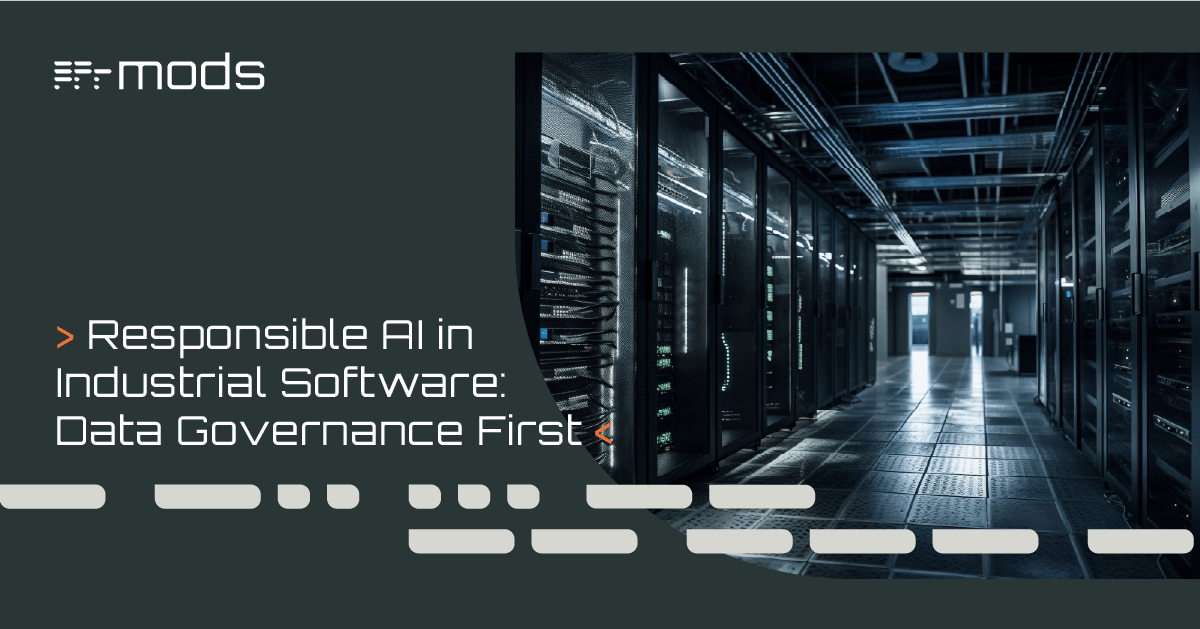
Successful software-as-a-service (SaaS) depends on trust. Beyond delivering functionality, software providers are responsible for protecting the data, intellectual property, and proprietary operational information entrusted to their digital systems. As AI capabilities become increasingly embedded within software products across industries, many organizations are now asking how they can benefit from innovation while maintaining security, governance, and control. It’s a reasonable, nay, essential question. Modern software increasingly depends on large volumes of data to deliver value. This opens a Pandora’s box of confusion revolving around how AI systems access, process, and use that information.
How does MODS approach AI?
At MODS, data security and governance are foundational software development principles. Our approach to AI is deliberate and measured, enduring that any AI-enabled capability is implemented responsibly and with appropriate safeguards. MODS intelligent industrial software solutions are not dependent on AI to function, allowing us to introduce AI features selectively where they deliver genuine value while maintaining robust governance standards.
MODS’ philosophy is simple: technology should solve real business problems, not be adopted simply because it is fashionable. We discuss AI-related concerns with our clients and recognize that organizations need confidence in how new technologies are implemented, governed, and controlled. It our role, as guardians of software products, to alleviate these concerns and mitigate risk on behalf of our owner-operator and EPC clients.
Responsible innovation sometimes means deciding not to apply AI when the risks outweigh the benefits. In industrial environments, where software supports the maintenance and operation of critical assets, reliability, traceability, and governance are essential. For this reason, MODS have intentionally limited AI’s role in the MODS Connect ecosystem to assistance rather than automation. This is an important distinction. AI can help users navigate MODS Connect software and implement it more effectively, but it does not make decisions, manipulate operational data, or act autonomously.
MODS operate according to a set of clear values, including acting with integrity. Trust is earned through transparency, accountability, and clear governance. These principles guide every development decision at MODS, including product design, software deployment, and client support. This includes shaping how we evaluate emerging technologies such as AI.
This philosophy does not mean avoiding AI altogether. On the contrary, MODS believe that AI can enhance the user experience and benefit organizations when applied thoughtfully, transparently, and within clearly defined boundaries. That is the belief that has informed our approach to AI within MODS Connect.
To that end and with the clear vision of supporting users without introducing unnecessary operational risk, one of the ways in which we’ve incorporated AI is via an optional Support Agent within MODS Connect.
Is AI optional in MODS Connect?
The MODS Connect Support Agent is entirely optional in the MODS Connect ecosystem and can be enabled or disabled according to client requirements. When disabled, it is fully inactive. This reflects a core principle of responsible AI implementation – clients remain in control of whether and how AI is used within their software environment. AI functionality should never be imposed as a prerequisite for harnessing the value of the MODS Connect platform, so it’s important that our clients have that choice.
What does the MODS Connect Support Agent do?
The Support Agent is not used to operate the software, power models, or automate decision-making. Instead, it is designed to help users learn the user interface more quickly by providing contextual guidance and "how-to" support. The objective is to improve user adoption, accelerate onboarding, and enhance productivity without affecting operational workflows.
In practice, the AI-powered Support Agent functions as an on-demand user guide. It helps users find information and perform functions faster while preserving established workflows, procedures, and human oversight. It does not modify records, make decisions, or perform any autonomous action. By limiting AI to this support role in MODS Connect, MODS deliver practical benefits of available technology while minimizing operational and governance risks.
How will MODS handle future AI capabilities?
Looking ahead, it’s important to recognize that AI capabilities will continue to evolve, and so too will the opportunities for it to enhance industrial software. It’s a delicate balance: harnessing the latest and greatest developments in a way that provides value over fanfare, while proceeding cautiously so as not to compromise security and ethics. Incorporating the most AI possible to keep ahead of trends is, simply, irresponsible.
The challenge for software providers is not to adopt the most AI possible, but to apply AI where it creates measurable value while maintaining security, governance, and trust. Responsible adoption requires balancing innovation with caution and ensuring that new capabilities are introduced only when benefits clearly outweigh any risks.
MODS have opted for this pragmatic approach, choosing function over form and prioritizing meaningful outcomes over technology for its own sake. Any future AI functionality introduced into our products will be assessed against the same principles that guide us today: security, transparency, client control, reliability, and measurable business value. As governance frameworks mature and client needs evolve, MODS will continue to evaluate AI opportunities carefully, responsibly, and with our clients' trust at the forefront of every decision.
Have questions about how AI is governed in your software environment? Let's talk.
This article was first published by Future Oil & Gas magazine, Issue 69, June 2026, under the title Responsible AI in Industrial Software: Putting governance before the hype.


 Lisa De Vellis, PE

 Lisa De Vellis, PE: Jul 28, 2026, 2:51:53 PM