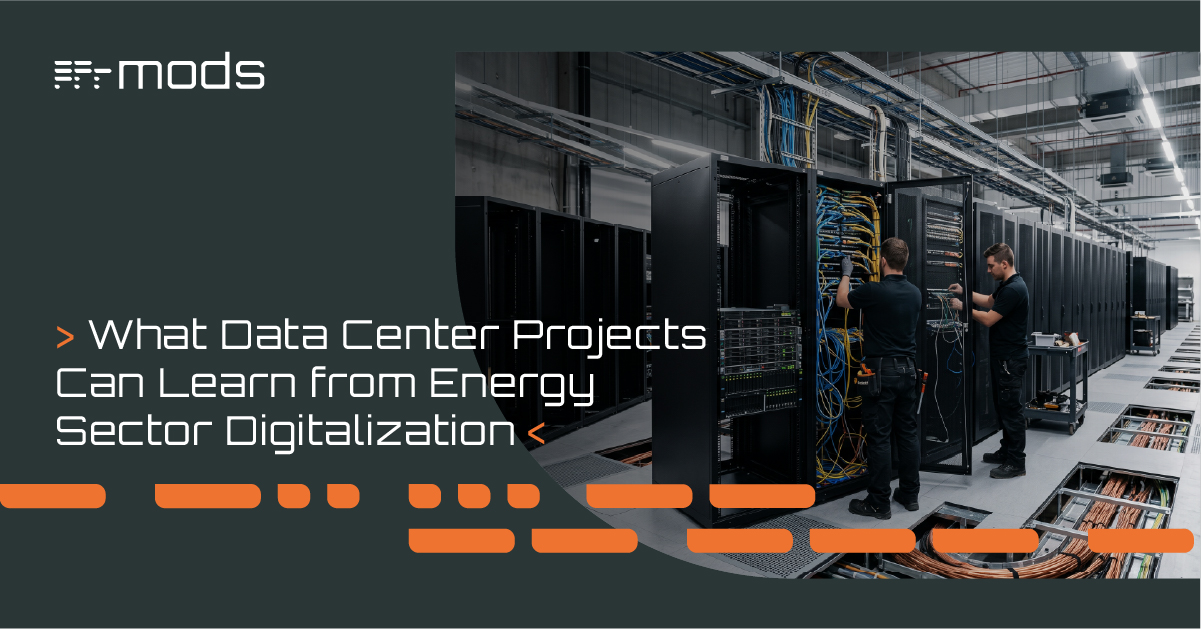
It may sound deafeningly obvious to suggest that data center projects would benefit from digitalization. After all, these facilities house digital infrastructure and underpin one of humanity’s most sophisticated technological revolutions. But focusing only on what data centers do misses a critical point. How data centers are built, commissioned, and maintained is just as important as how they operate.
And right now, there’s a gap.
Data centers can close this gap by adopting the same digital, structured, and data-driven project execution methods the energy sector has already proven — including Advanced Work Packaging, integrated data environments, and real-time project controls.
Despite their advanced purpose, many data center development projects still rely on fragmented workflows, inconsistent data practices, and construction methodologies that don’t reflect the sophistication of the asset itself. As the sector scales rapidly, that gap is becoming harder—and more expensive—to ignore.
A Market Scaling Faster Than Its Methods
The data center boom is well documented: thousands of new facilities are expected globally over the next decade, with sites growing larger and more complex. What’s less discussed is whether project delivery models are evolving at the same pace. Newsflash: they’re not.
This expansion is happening faster than construction practices, digital maturity, and policy frameworks can keep up. The result? Increasing pressure on cost, schedule, safety, and quality on projects that are already operating in mission-critical environments.
The irony is clear: data centers power the digital economy, yet their delivery often lacks the digital rigor required to match.
Data Centers Are Industrial Assets—Not Just IT Infrastructure
To close this gap, it helps to reframe how we think about data centers.
They are not simply IT infrastructure. They are industrial, power-centric, safety-critical assets with far more in common with energy projects than most people realize.
Like power generation or oil and gas facilities, data centers operate with a near-zero tolerance for failure. They depend on complex electrical systems, strict energization protocols, and continuous monitoring. They require disciplined commissioning, robust lifecycle data, and flawless integration with grid infrastructure.
These dichotomous facilities also share the same realities:
- Complex permitting and compliance requirements
- Highly capital intensive with ROI pressures
- Vulnerability to supply chain volatility
- Tight delivery timelines with limited margin for error
This overlap between data centers and energy assets ought to be instructive.
What data center development can learn from a proven digital playbook
The energy sector has spent decades solving the very challenges data center development is now facing. Out of that experience has emerged a mature, field-tested approach to project execution—one that is inherently digital, structured, and data-driven.
This includes:
- Advanced Work Packaging (AWP) for predictable, constraint-free project execution
- Integrated data environments to eliminate silos and minimize administration
- Real-time project controls for visibility and informed decision-making
- Structured data models that carry through the full asset lifecycle
Data center developers are fortunate in that they don’t have to reinvent the wheel. Instead, they can adopt a proven playbook from the energy sector, accelerating project methodology and maturity by years.
Where Data Center Projects Go Wrong
Many data center programs still struggle with familiar issues:
- Fragmented data and disconnected teams lead to misalignment and inefficiencies.
- Unclear scope and requirements drive costly rework and delays.
- Late-stage design conflicts disrupt schedules and increase risk.
- Inaccurate or inaccessible deliverables impact commissioning and operations.
- Fast-track pressure compromises productivity and safety.
At the root of these challenges is a common thread: weak digital project and asset foundations.
Without structured data, integrated systems, and real-time visibility, even the most well-funded projects become reactive instead of proactive.
How MODS enable better outcomes for data center programs
This is where digital solutions—specifically those purpose-built for complex industrial projects—make a measurable difference.
MODS intelligent industrial software solutions bring the discipline of modern energy-sector project delivery into data center development. The focus is simple: create a connected, reliable, and traceable data environment from day one that streamlines workflows for safe, predictable projects.
In practice, here’s what that looks like:
- A Single Source of Truth
MODS establish structured data frameworks that ensure clear lineage across the entire project lifecycle. From engineering through commissioning and into operations, every stakeholder works from consistent, validated information.
- Constraint-Free Execution with AWP
By enabling AWP methodology, MODS help teams identify and remove constraints early, align engineering and construction, and maximize productive time on site without compromising safety or quality.
- Real-Time Visibility and Control
Integrated dashboards and live data environments provide at-a-glance insights into project status, risks, and progress. This shifts decision-making from reactive to proactive.
- Quality-Assured Deliverables
Automated validation and standardized data checks ensure that all outputs are accurate, complete, and ready for downstream project execution, reducing rework and accelerating commissioning.
- Seamless Handover to Operations
MODS support commissioning readiness with structured, verified data that transitions smoothly into operations, creating a strong foundation for long-term asset performance.
MODS take data centers from reactive to predictable delivery
The value of a digital project approach is in its efficiency and predictability.
When data is structured, accessible, and connected:
- Risks are identified earlier
- Teams are aligned from the outset
- Productivity increases across the board
- Safety improves through better visibility
- Projects are delivered faster, with fewer surprises
In short, digitalization transforms project delivery from a fragmented, reactive process into a controlled, repeatable system.
An opportunity for data centers to leapfrog
Data centers are at a unique time in their evolution. Unlike more mature sectors such as oil and gas, they are not burdened by decades of legacy systems and entrenched practices. They have the opportunity to adopt modern, digital-first methodologies from the outset, avoiding the painful transitions others continue to navigate.
By embracing proven approaches from the energy sector, supported by tools such as MODS industrial software solutions, data center developers can:
- Reduce waste and inefficiency
- Improve safety and compliance
- Accelerate schedules without increasing risk
- Deliver higher-quality, operations-ready assets
The Bottom Line
Data centers may power the digital world, but their success depends on how effectively they are delivered in the physical one.
Recognizing data centers as industrial assets does not dumb them down, it offers an opportunity for them to capitalize on their early maturity and leapfrog into a future of optimal construction performance. Adopting the proven digital tools and advanced construction methodologies is what will get them there.
With the right foundations in place, data center developers can keep pace with demand and set a new standard for how this critical infrastructure is built, commissioned, and maintained.
Want to see what a connected, single-source-of-truth data environment looks like for your next data center build? Let's talk.


 Lisa De Vellis, PE

 Lisa De Vellis, PE: Jul 28, 2026, 2:51:53 PM