Industrial sector digital transformation, at whatever stage, demands more than off-the-shelf software. The myriad of logistical, safety, cultural, knowledge, and financial barriers too easily impede the uptake of new software solutions in complex industrial environments. Business as usual gets disrupted as users and workflows adapt to new systems. And frustration abounds when software is lacking certain features or functions that would greatly enhance its efficacy in a particular setting.
Especially in the industrial sector, digital transition pipelines are often clogged with grandfathered-in infrastructure, information, and mentalities. Legacy systems, established workflows, compliance obligations, and deeply ingrained ways of working all add layers of complexity that challenge a smooth transition to even the most useful software. Software that looks compelling in a demo can quickly become a burden if it forces organizations to bend their processes unnaturally, or if it introduces downtime at critical moments. In this context, the success of digital transformation depends as much on how software is delivered and supported as on what it can do.
Smaller more agile software developers leverage their David-like skill and finesse to overcome Goliath-like digital transformation impediments. Unlike larger, more rigid off-the-shelf providers, smaller, more agile firms are not constrained by one-size-fits-all deployment models. They are able to listen closely, respond quickly, and adapt their products in line with real-world project, business, and operational demands. This agility becomes especially valuable when business continuity is a non-negotiable.
At MODS, agility is a core value.
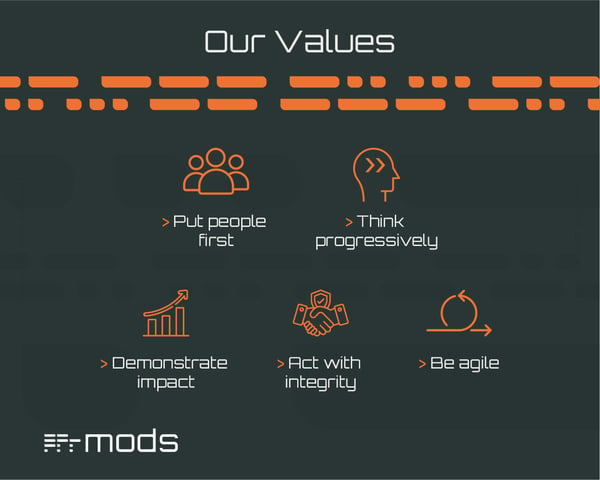
Agility, in preparation for and during the onboarding process, means more than handing over a pristine software package ready for use. It means tailoring the software a client receives around their specific onsite and business realities. It means recognizing that digital transformation is not a single event, but a process that unfolds over time, typically alongside ongoing projects, active assets, and busy teams.
To ensure that investment in our software translates into immediate value with seamless, fast adoption and quality-assured use for optimal ROI, MODS offer two key advantages that are often missing from off-the-shelf solutions:
- Help maintaining business continuity during a transition to our system.
- Customized software enhancements or the addition of new features to best meet needs.
When it’s done well, industrial sector software providers aren’t merely vendors; they’re trustworthy partners invested in the process of digital enablement. The difference becomes apparent not just at the point of sale, but during onboarding, adoption, and day-to-day use moving forward. So, what does MODS’s agility translate to in practice?
Business continuity is a big one. Project timelines don’t come to a screeching halt as employees hop on the learning curve of a new software product. Instead of expecting teams to pause work while they setup systems, populate data, and learn new interfaces, MODS actively supports clients through (and beyond) the transition period with a pick ‘n’ mix of Digital Enablement services.
MODS can take care of all the initial data entry and setup so that a quality-assured, pre-populated system is being handed over, ready for immediate use. This approach eliminates one of the most common friction points in transitioning to a new software product: the gap between implementation and productivity. Users log into a system that already reflects their project, workflows, and documentation, rather than a blank platform that requires laborious configuration before it can be put to use.
If, for example, our digital work package system is being onboarded, our experts can even write your work orders for you while providing training to fill any skills gaps during a transition period. This allows project teams to continue delivering work while simultaneously building familiarity and confidence with the new system, which facilitates uptake. Learning happens in context, supported by real data and real tasks, rather than abstract training exercises detached from day-to-day workflows.
This prioritization of business continuity is particularly important in industries where downtime carries safety, financial, or regulatory consequences. Agile software support during transition to a new tool helps mitigate risk, maintain momentum, and ensure that digital tools enhance performance rather than disrupt it.
As for software customization, we do everything from ensuring that our software will knit in seamlessly with any of your existing systems to creating brand new tools by request. No two organizations operate in exactly the same way, and no single software setup can account for every project nuance out of the box. Agile development allows those nuances to be addressed directly via tweaking the software to suit.
Sometimes customization is about refinement — enhancing an existing function so it better supports a specific workflow, reporting requirement, or approval process. Other times it involves adding entirely new features that respond to emerging needs or unique use cases. Because MODS develop and maintain their own software, bespoke functions or templates are not bolted on as workarounds, but are integrated cleanly into the software to maximize efficiency from day one.
This flexibility also extends to integration with existing systems. Rather than ignoring potential challenges related to a client’s existing systems or, worse, forcing clients to abandon existing systems, agile providers can ensure new software works in harmony with established tools and systems. System integration is essential and the result is a more cohesive digital ecosystem, where information flows smoothly and users are not burdened with duplicate data entry or fragmented processes.
Ultimately, agility in industrial software delivery is about alignment. Alignment between software providers and a client's business and on-the-ground project needs. Alignment between developers and users. Alignment between the immediate needs of a short-term project and a long-term digital strategy. By safeguarding business continuity during any software transition and providing impactful customization to suit, agile software providers help organizations realize the full potential of their digital investments — without unnecessary disruption, downtime, and financial consequence along the way.
Digital transformation only delivers results when adoption, continuity, and real-world use are planned from the start.
Our Digital Enablement brochure breaks down how to ensure fast uptake, quality-assured implementation, and ROI from Day One — without disrupting live projects or teams.


 Lisa De Vellis, PE


 Lisa De Vellis, PE: Jul 28, 2026, 2:51:53 PM